Promotion of a Recycling-oriented Society
Our approach
to a circular economy
The Company positions the promotion of resource circulation as a key management issue and advances waste reduction and resource recovery through the efficient use of limited resources. These efforts not only mitigate environmental impact but also enhance the Company's credibility and competitiveness, leading to long-term value creation.
The Company is committed to reducing, reusing and recycling industrial waste in order to contribute to the realization of a circular economy.
Initiatives for promoting
a circular economy
in business operations
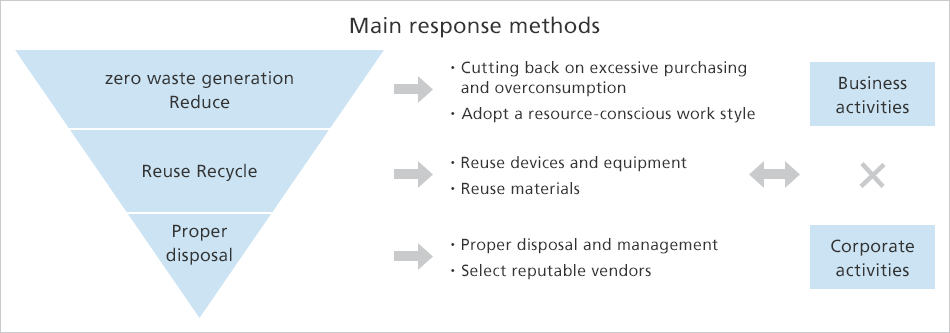
Reduce
The Company strives to reduce paper use in the sale of mobile information devices by making individual packaging boxes smaller, converting instruction manuals and other enclosed documents into applications, and utilizing iPads in its stores.
In addition, to replace conventional paper-based invoices, the Company launched the Online Charges Guide starting with statements issued in October 2006, enabling customers to view electronic billing statements over the Internet using a SoftBank mobile phone or a PC. This service is provided as a basic service to all individual subscribers.
Reuse
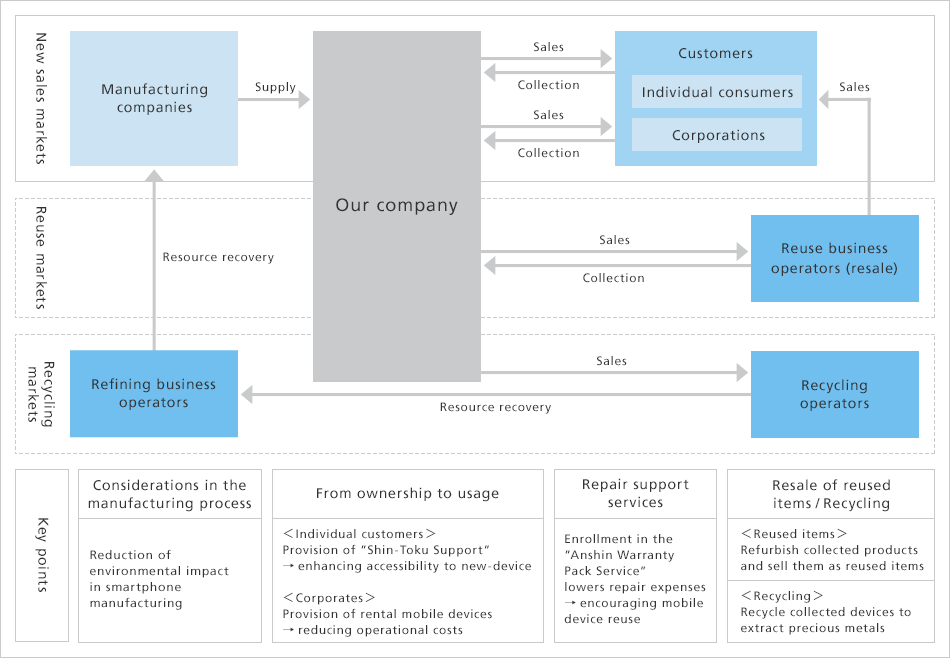
The Company efficiently collects and resells mobile phones previously sold or rented to customers. As the domestic and global used smartphone markets have expanded in recent years, the Company will continue to enhance its value-added services in line with increasingly diverse customer needs and respond to market demand.
Recycle
The Company participates in the Mobile Recycle Network (MRN), an industry-wide initiative for collaborative collection, and collects not only mobile phones sold by the Company but also those sold by other companies. Traditionally, telecommunications operators collected and recycled only the mobile phones they sold. However, MRN was established in 2001 as a sustainable framework that prioritizes customer convenience and societal considerations, and it has operated for more than twenty years.
Through these initiatives, the Company collected 2.83 million used mobile phones, totaling 500 tons, for reuse and recycling in FY2025 and properly processed 100% of them through recycling/reuse. The Company achieved its initial cumulative target of 14 million units for the period from FY2020 to FY2025 and will continue working to further increase collection volumes.
In addition to mobile phones and other communications devices, the Company also promotes resource recycling for waste materials from telecommunications infrastructure, including cables, switching equipment, and utility poles, when network facilities are upgraded or removed.
Additionally, the Company supports the recycling targets established by GSMA (GSM Association), a global association of telecommunications operators, which aim to collect recycled devices amounting to at least 20 percent of annual new mobile phone sales and to ensure that all collected devices are processed using non-incineration methods. The Company had already achieved the GSMA targets as of March 2026 and will continue to work to maintain recycling performance above the required levels.
Going forward, in order to further increase collection volumes, the Company will continue to raise awareness of its recycling initiatives among business partners and customers, while further strengthening collaboration with MRN and other organizations and enhancing communication related to the reuse and recycling of used mobile phones. The Company also conducted a consumer survey to better understand awareness of mobile phone recycling, willingness to participate in collection programs, and issues related to promoting collection. Going forward, the Company will use the insights gained through such surveys and analyses to promote the reuse and recycling of used mobile phones.
Initiatives for resource circulation in mobile phone services
Tracking of Waste Electrical and
Electronic Equipment Generated from Sold Products
Waste electrical and electronic equipment (WEEE) generated from sold products is managed using device identification numbers such as IMEI to ensure proper reuse and recycling. All devices collected through the Company's recovery initiatives are either recycled or reused.
| Information tracked by the Company |
|
|---|
Implementing educational activities to teach about recycling
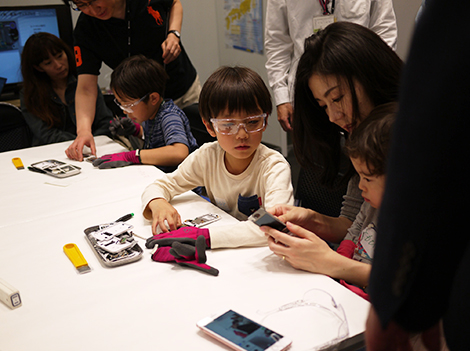
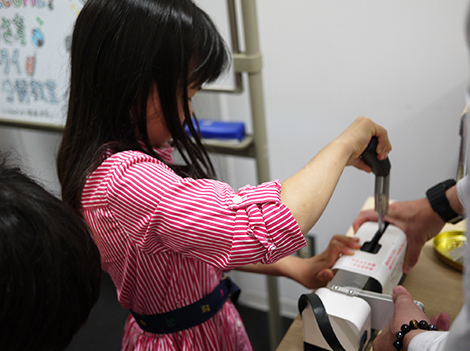
The Company holds "Risaikuru" environmental classes for children at SoftBank shops across Japan to help them learn the importance of recycling through the experience of disassembling mobile phones. The classes are designed to help children learn about the structure and materials of mobile phones by actually taking them apart and using the disassembled parts to create crafts. In this way, children can develop creativity and gain knowledge about recycling while having fun. More than 3,230 people have participated in these classes from April 2018 to the end of March 2026.
In addition, environmental classes are held at SoftBank shops nationwide, open to all customers regardless of whether they have a contract with the Company.
Value creation model for reducing environmental impact
The Company is advancing resource circulation throughout the value chain as part of its efforts to reduce environmental impact.
-
The Company's strengths in the circular economy - Monetization through effective utilization of used resources
- Avoidance of disposal costs
Ensuring and Strengthening - ①Maximizing recycling efforts
- ②Maximizing reuse efforts
Key initiatives - ①Monetization through resale of collected mobile handsets / monetization through resource reutilization of decommissioned base station equipment and used mobile handsets
- ②Monetization through sales of reused products both domestically and internationally
Risks / opportunities Risks /
oppor-tunitiesRisk - Shrinking new mobile handset sales market
- Outflow of mobile handsets to other companies due to expansion of the reuse market
Opportunities Oppor-tunities - Increased collection and revenue through expansion of the reused mobile handset market
- Revenue growth from rising prices of scarce minerals and other resources
-
The Company's strengths in the circular economy - Improving resource efficiency through optimization of data centers, network centers, and base station facilities
- Sharing base stations with competing operators
- Providing mobile phones through rental and related services
- Diversification of the communication services provided
Ensuring and Strengthening - ①Complete implementation of efficient resource utilization for equipment and strengthening resource conservation
- ②Promoting rental services
- ③Advancing resource-efficient technology services and standalone SIM sales
Key initiatives - ①Energy conservation through EMS implementation at data centers and reduction of chiller operation
- ②Deployment of rental services for corporate mobile devices
- ③Provision of eSIM services
Risks / opportunities Risks /
oppor-tunitiesRisk - Cost impacts from reduced stability of energy supply and surging energy prices
- Opportunity losses caused by delays in responding to diverse sales channels
Opportunities Oppor-tunities - Cost reduction through efficient resource utilization
- Revenue growth from expansion of the rental market
- Expansion of standalone e-SIM/SIM sales through inbound and outbound market growth
-
The Company's strengths in the circular economy - Use of certified paper that verifies sustainable forest management
- Joining resource circulation organizations
Ensuring and Strengthening - ①Promoting utilization of products with resource conscious labeling
- ②Strengthening partnerships
Key initiatives - ①Utilization rate of PEFC- and FSC-certified paper for internal use (approx. 80%)
- ②Membership in Circular Partners
Risks / opportunities Risks /
oppor-tunitiesRisk - Reputational risk from using non–resource-conscious materials
- Productivity decline caused by closed internal know-how practices
Opportunities Oppor-tunities - Acquiring insights through external networks
- Accumulation of circular business knowledge and building competitive advantage
- Enhancement of brand image through use of certified materials
-
The Company's strengths in the circular economy - Strengthening employees' know-how and knowledge
- Promoting appropriate disposal, collection, and reuse by departments and employees
Ensuring and Strengthening - ①Providing opportunities for sustainability education
- ②Offering awareness initiatives to encourage proper collection and reuse
Key initiatives - ①Implementation of e-learning (FY24 participation rate: approx.92%)
- ②Establishment of an employee waste disposal desk and provision of procedural manuals
Risks / opportunities Risks /
oppor-tunitiesRisk - Stagnation of resource recovery and increase in waste due to insufficient educational outreach
Opportunities Oppor-tunities - Promotion of resource collection and securing profits from sale of valuable materials
- Expansion of new businesses and innovation through increased employee awareness
-
The Company's strengths in the circular economy - Collaboration partners in the reuse and recycling business
- Provision of non-plastic-derived products and items utilizing unused resources and waste materials to customers
- Enhancement of environmental and resource utilization awareness among society and customers
Ensuring and Strengthening - ①Identifying and reinforcing relationships with reputable waste disposal contractors
- ②Facilitating mobile device collection at retail locations
- ③Providing awareness opportunities to customers
Key initiatives - ①Conducting vendor audits and selecting reputable waste contractors
- ②In-store device collection and stable recovery through offering the Shin-Toku plan
- ③Conducting the customer environmental education program "Risaiku-ru"
Risks / opportunities Risks /
oppor-tunitiesRisk - Increased capital costs for providing reuse and recycling services during periods of customer or societal acceptance stagnation
Opportunities Oppor-tunities - Expansion of business opportunities in the reuse and recycling sector
- Enhancement of the corporate image through the use of nonplastic products and recycled materials, and provision of educational opportunities
-
The Company's strengths in the circular economy - Effective utilization of resources through reuse of scarce minerals and similar materials
- Reducing water usage through advanced data center technologies
- Reducing use of plastic-based products and utilizing products made from unused resources and waste materials
Ensuring and Strengthening - ①Promoting the reuse of resources such as scarce minerals through reuse and recycling
- ②Advancing conservation of natural capital such as water
- ③Promoting the use of low environmental-impact materials
Key initiatives - ①Setting materiality KPIs and driving them as company-wide initiatives
- ②Reduction of water usage through advanced data center technologies
- ③Use of certified shopping bags and production/internal use of business cards made from kudzu-based materials
Risks / opportunities Risks /
oppor-tunitiesRisk - Resource exhaustion of scarce minerals and reputational damage due to stagnation in resource initiatives
- Constraints on water and resource use and business restrictions due to regulations
Opportunities Oppor-tunities - Stabilizing handset procurement through steady supply of recycled rare metals
- Expanding markets for waste and unused resources, fostering new business creation
Common outputs
| GSMA Targets | Achieve a recovery rate of at least 20% against new handset sales | Achieved 20% or more |
|---|---|---|
| Ensure 100% proper processing (zero landfill rate) of recovered handsets | Achieved 100% | |
| Total number of reused and recycled units (FY2020 – 2024) | 15.3 million | |
Common outcomes
Ensuring the sustainability of natural capital and resources to contribute to social, industrial, and economic development.
SDGs12
"Responsible Consumption and Production"

SDGs13
"Climate Actions"

SDGs15
"Life On Land"
